





The world of generative AI
For many tasks artificial intelligence (AI) can be of great use to the conservation professional, even if we have little idea of what the risks are or where this tool is taking us.

|
| The first image, generated using the image diffusion service Midjourney, shows a run-down, 1960s-style office development on a street. The second shows alterations added using ‘inpainting’ to simulate a new development and public realm scheme. |
When people refer to AI these days they are typically referring to ‘generative’ AI (or ‘genAI’) which is AI that generates content. This is based on an invention called a transformer. ‘Generative’ and ‘transformer’ are the G and T in GPT, and the P stands for ‘pretrained’, which refers to the massive amount of training data needed.
A transformer is a type of neural network architecture. It was invented in 2017, although the present AI chapter is the latest in a field (deep learning) that has been chugging away quietly in the background for more than 60 years, albeit picking up over the past 12. Transformer architecture, in combination with greatly scaled size and training data, has heralded a rapid acceleration in the fields of natural language processing and computer vision. With the 2022 release of ChatGPT, a transformer-based chat bot that can answer questions with levels of sophistication hitherto reserved for science fiction, the technology entered the public consciousness.
The ability to answer questions across a broad range of topics rather than only specialisms for which they have been trained, and in natural language indistinguishable from that of humans, marks out these ‘large language models’ from their predecessors.
Currently the modalities and uses to which generative AI can be applied are being broadened and extended, with systems increasingly able to ingest, manipulate and produce music and sounds, images, video, text and geometry. Such systems are under active development, and the financial success of OpenAI, makers of ChatGPT, has caused the rate of research and development to increase rapidly, driving the emergence of an ecosystem for knowledge work. These tools are being applied somewhat chaotically. A ‘throw it and see what sticks’ mentality is changing how we interact with computers and will continue to do so until this development phase plateaus. Whether that is followed by further sinusoidal waves of progress or another AI winter (there have been several) remains to be seen, but even if progress stops tomorrow the change that has happened since 2022 has been substantial.
How does this apply to conservation? There are several questions to consider:
- What tasks constitute the work of a conservation specialist?
- Of those tasks, which would suit the involvement of a current generative AI system?
- For the tasks where genAI involvement could be beneficial, how can this be done in a way that maximises benefit and minimises harm to the work?
- What second-order harms may we need to be aware of, beyond potential harm to the work? This might include harms to society or the environment.
- What developments would need to take place for the jagged technological frontier of things genAI to advance further into the list of tasks a conservation specialist carries out?
I do not know what we will be doing in five years, but my guess is it will be very similar to what we do now. That said, just as typing an email by computer, and dictating an email to your phone, are similar in one sense, they are also quite different.
Concern about genAI, or even hostility towards it, is in many ways quite reasonable. The technology poses problems ranging from increased consumption of natural resources, concentration of power in a small number of places, increasingly tying people to their computers, reducing the quality of work without anyone realising or caring, and more.
Let us consider some cases that are already being uncovered.
You are a conservation officer working in a local authority. An agent sends you a specification for some works that are taking place on a large historic building, and you need to appraise the suitability of the proposals. The specification is 130 pages long, and most of it is standardised boilerplate. You could either trawl through the whole thing manually, trying to find the bit relating to render specification or guttering. Alternatively, you could do a keyword search, click through all the mentions of a given word or phrase, and hope that everything relevant starts to make sense. Or you could ask a large language model such as ChatGPT, Claude, Gemini or Mistral.
Or you are a heritage consultant writing a complex design, access and heritage statement for a regeneration project. Part way through, a new edition of the National Planning Policy Framework (NPPF) is released. You could manually go through the new edition, checking for all the new paragraphs and cross-checking the numbers against the ones in your report. Or you could try a large language model.
Or you are an architect exploring some early ideas in an urban context. Your usual tools at this stage consist of direct site observation, photos, sketching, Photoshop and your own experience. However, with genAI suited for image generation, such as Stable Diffusion, you could rapidly explore a wide range of different ideas in context. For instance, here is a regular, free picture of a site in Dorking. Using tools in Stable Diffusion called inpainting and upscaling, I was able to change one of the building’s fronts in just a few seconds. I made it look like it has timber panels and an awning.
The two images in this article were generated completely using the image diffusion service Midjourney. This uses text, or text and images in combination, to produce a picture. The initial image was designed to resemble a photograph of a 1960s office development in an English high street.
Using Midjourney’s ‘inpainting’ tool, in which an area of an image can be selected and re-generated using a different instruction, I carried out the following changes:
- Replaced the highway in the foreground with a public realm scheme consisting of paving, planters with plants, and wide pavements.
- Replaced two of the central buildings to simulate a new development of attractive, modern, colourful houses in a row, with gabled roofs.
- Replaced the ground floors of this development with a row of shop fronts to simulate a mixed-use development.
- Added a pair of street trees with autumn colours into two of the planters.
There are numerous intricacies and it is not as simple as this makes it sound. A few architects have become quite technically proficient with this sort of program, and in the public sector generally, there is an impetus to understand AI, though it is still very niche. Central government is pushing in the interests of efficiency and competitiveness. I reflect on a planning system hackathon held in May by MHCLG and the Government Digital Service at www.aienvisions.com.
This article originally appeared in the Institute of Historic Building Conservation’s (IHBC’s) Context 184, published in June 2025. It was written by Sammy Woodford, a conservation and design officer working at Cumberland Council. He writes about generative AI and place at a.i.envisions.com.
--Institute of Historic Building Conservation
Related articles on Designing Buildings Conservation.
- Artificial Intelligence and its impact on the project profession.
- Artificial intelligence and surveying.
- Artificial intelligence for smarter, safer buildings.
- Artificial intelligence in buildings.
- Artificial intelligence in the construction industry.
- BSRIA publishes Artificial Intelligence in Buildings white paper.
- Conservation area.
- Conservation.
- Heritage.
- Historic environment.
- IHBC articles.
- IHBC.
- Key AI related terms to be aware of, with UK government explanations.
IHBC NewsBlog
IHBC sponsors Gardens Trust event 23-4 Sept 2026
.jpeg)
'Learning from the Past, Shaping the Future’ takes place in Milton Keynes
Renovations to Frank Lloyd Wright's Fallingwater complete
.jpg)
World Heritage Preserved project opens house for tours again
Shakespeare Birthplace Trust places Hall's Croft on HAR Register
Stratford-upon-Avon home of Shakespeare's daughter is 'At Risk'
Lady Grange’s House repaired on St Kilda
.jpg)
National Trust for Scotland repairs stone cleit with link to famous island resident
Griff Rhys Jones on BBC Radio 4 Today programme
,_Green_Lane,_Derby.jpg)
The Victorian Society’s President unveiled its latest Top Ten Endangered Buildings 2026.
Need a MATE? Book your place now.

IHBC offers free webinars on applying for IHBC accreditation (Full & Associate).
UK Stained Glass Repository finds windows new homes

How are stained glass windows are rescued, stored and repurposed?
APPGEBE report sets high aims for quality
'Government must not sacrifice quality in drive to build 1.5m homes'
New measures protect Historic Shipwrecks from heritage crime

Underwater cultural heritage benefits from new HE guidance
How could the City of London skyline look in 6 years' time?

Visualisation shows approved planning applications as completed buildings
National Trust for Scotland calls for VAT cuts
Heritage neglect is encouraged by current policies
IHBC's 'Context' Issue 186 features Industrial Heritage
IHBC's members' journal reports on the challenges of conserving infrastructure
Book now for IHBC Annual School 2026
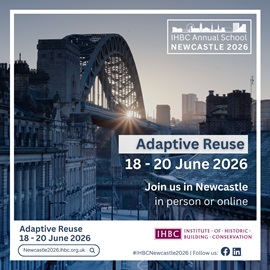
IHBC Annual School is taking place 18-20 June 2026 in Newcastle
RICHeS Research Infrastructure offers ‘Full Access Fund Call’
RICHeS offers a ‘Help’ webinar on 11 March
Latest IHBC Issue of Context features Roofing
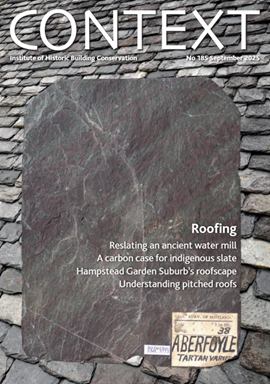
Articles range from slate to pitched roofs, and carbon impact to solar generation to roofscapes
Three reasons not to demolish Edinburgh’s Argyle House

Should 'Edinburgh's ugliest building' be saved?
IHBC’s 2025 Parliamentary Briefing...from Crafts in Crisis to Rubbish Retrofit
IHBC launches research-led ‘5 Commitments to Help Heritage Skills in Conservation’
How RDSAP 10.2 impacts EPC assessments in traditional buildings

Energy performance certificates (EPCs) tell us how energy efficient our buildings are, but the way these certificates are generated has changed.